
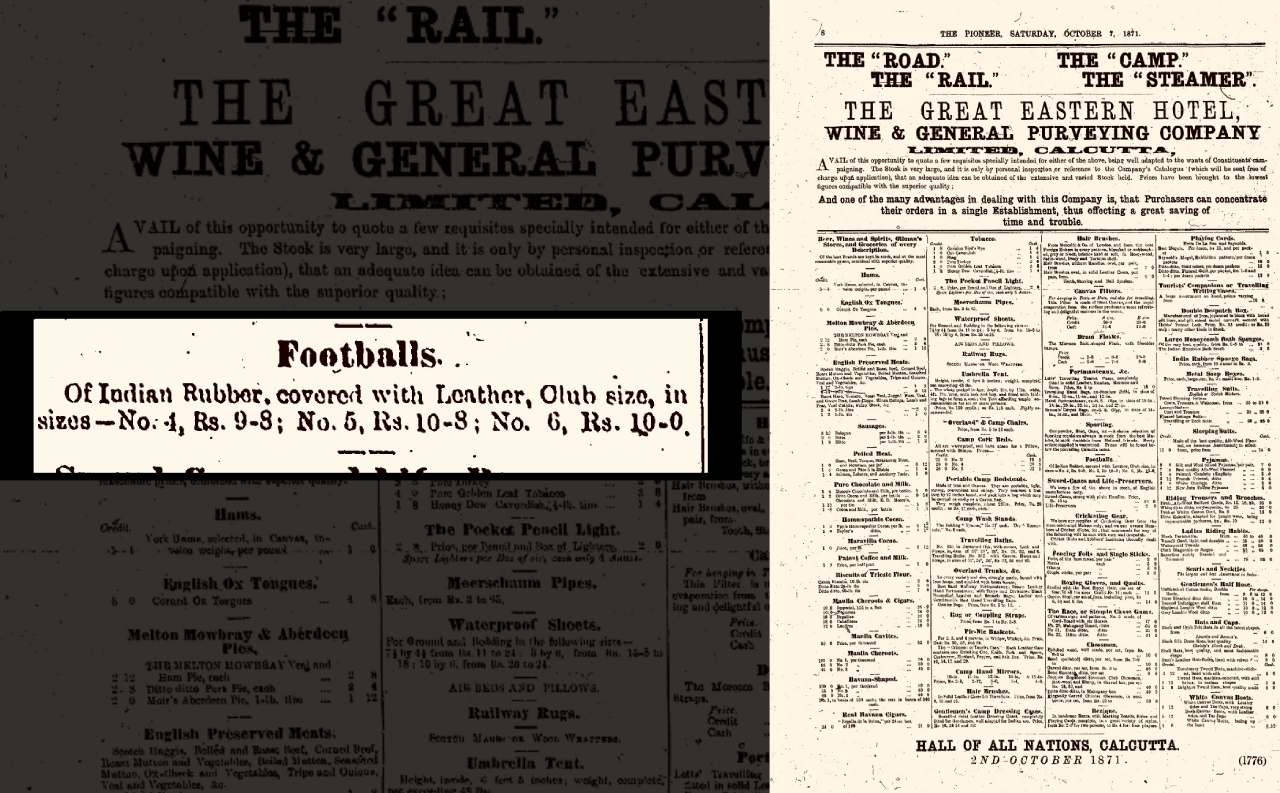
An advertisement appearing in The Pioneer on 7th October 1871 announces a large sale at the Great Eastern Hotel in Calcutta. Alongside such other desirables as Melton Mowbray Pies and Railway Rugs, the sale also included a range of footballs for sale. The balls are made from India Rubber, covered in leather and available in four different sizes. Collection of Projit Bihari Mukharji
Skip to content


The material culture of football in Bengal
The material culture of football in Bengal has evolved dramatically since the late nineteenth century. Early players used heavy leather balls stitched by hand and often played barefoot or in simple canvas shoes. By the early twentieth century, leather boots with nailed studs became increasingly common, while improvements in tanning, stitching and rubber technology produced more durable equipment. After Independence, factory-made boots, synthetic materials and standardized balls transformed the game. These objects – balls, boots, jerseys, whistles, trophies and club badges – not only shaped how football was played but also embodied changing technologies, industries and sporting identities across Bengal.
By February 1875 we find another advertisement in The Pioneer. By then the one-off sales had given way to a fixed store, Wyman’s on Hare Street, Calcutta. Alongside balls, footballers could now also buy air pumps to inflate their footballs. Wyman’s however was not a sports store. It also sold cheap editions of popular novels, cabinet photos of beautiful actresses and much else. Collection of Projit B Mukharji
Around the 1890s the specialized sports store began to emerge in Calcutta. One of the first was Eroom & Co. on Dhurromtolla Street. They advertised only football gear in The Pioneer in 1892. Footballers could buy both footballs and rugby balls. They could even buy just the bladders. This ad also shows the emergence of sporting brands, through J. Salter of Aldershot. Collection of Projit B Mukharji
Another advert from Eroom & Co. the following year shows further diversification of football’s material culture. Apart from branded balls, we see the emergence of waterproof balls, different types of footballing boots, bladders and even “brass inflaters”. Collection of Projit B Mukharji
By 1906, following the Swadeshi Movement, we see the emergence of explicitly “Swadeshi Footballs”. The main manufacturer was Jhanda Singh Uberoi, originally from Sialkot, but eventually settled in Calcutta. Uberoi offered a number of types of balls, such as “Rajput”, “Swadeshi”, “Goal-finder” etc. as well as an even larger number of additional items like, rule-books, goal-nets, shin guards, inflators etc. As a good nationalist, Uberoi also advertised in the Amrita Bazar Patrika rather than the English-owned Pioneer. Collection of Projit B Mukharji
By 1917 there were many other local sports goods businesses, such as Dutt, Dass & Co. of Bentinck Street, Calcutta. But unlike Uberoi, they were mainly importers of foreign equipment. Collection of Projit B Mukharji
Advertisements from 1920 showed that new manufacturing firms such as The Pioneers Sports Depot on Lindsay Street were directly appealing to customers not to buy from middlemen. Their adverts also showed further diversification of footballing gear, we now heard of such new items such as solutions for mending bladders, lacing awls, anklets, knee caps, football knickers, etc. Collection of Projit B Mukharji